Saturday, January 1, 2011

Beijing Taxi By the “Numbers”


“欢迎乘坐北京出租。也感谢您提出宝贵的意见并进行监督。Welcome Passengers. Welcome to take Beijing Taxi. Your advice on our service is appreciated.” So begins your cab ride, after your driver flips up the red-lit 空车 switch on the front roof top to start the meter.


All Beijing cabs have license plates 京B xxxxx. If the leading letter is not B, it’s not a proper Beijing cab. Most cabs are either VW Jettas or Hyundai Elantra and seat up to 4 (1 in front, 3 in back).

Fare: 10 rmb for the first 3 km, 2 rmb / km thereafter; 2 rmb / 5 mins under 12 kph. These days because of rising gasoline prices, you need to pay a surcharge of 1 RMB for all rides longer than 3 km. Fares after 11 PM incur a 10% surcharge. Single way rides over 15 km incur a 10% surcharge.

If you are sitting next to the driver, you will see the driver’s registration (with the driver’s name, photo, ID number and the cab company) on the dashboard facing you.


Lowest drivers ID number 4xxx I’ve seen, highest number 285xxx in 2010.

9-10xxxx in ’95, 15-16xxxx in 2000, 28xxxx in 2010; These last 7-8 years, each year saw 10000+ new cab driver (replacing retired and more double shifts).

There are 66,000-67,000 Taxis and more than 100 taxi cab companies.

Over 100,000 current taxi drivers

Largest Taxi Company BeiQi (北气, Beijing Beiqi Taxi Company) has over 5,500 taxis and 11,000 drivers; smallest taxi company has less than 1 dozen cars…

Average Fees and Costs for the Driver: (company fees) 3000-3500 rmb / month for each shift of a double shift; over 4,000 rmb / month for a single shift. For each driver, 120 rmb / day of gasoline; they try to gross 600 rmb / shift and the typical mileage is 500-600 km / day. The cab company doesn't cover maintenance. The subsidy for gasoline price hike is 600 rmb / cab / month.

Typical double shift is alternate days, though there are day-night shifts (there are drivers who are husband-wife teams).

Numbers on the Receipt. The numbers are 0xxx (Cab company ID), xxxxxxxx (8 digit cab company phone), B-Xxxxx (taxi license plate), xxxxxxx (driver ID), Date, Time (start to end), 2.00 (rmb /km), mileage, wait time (time under 12 kph), 0 or 1 (state, i.e., return or one-way), and (finally) total fare.

Starred taxis. Some taxi drivers are “starred,” that is, they have been nominated and judged worth of “starred” status. For these drivers, their light on top has a star. Also their dash board licenses also display the star or stars. I have seen drivers with 4 stars. Supposedly when these drivers get their fifth star, their license gets a big star in place of the 4 stars. I have never seen a driver with one big star. (Those whose partners are starred get a break, as the cab has a star on top, but you can tell that there is no star on their dashboard ID.)

Prehistory. 

My first trip to Beijing was in 1996. Most taxis then were 面的 (Mian Di, literally, “bread taxi”). (Beijing-ers call taxis 的 “di,” pronounced “dee” and short for 的士, which is how Hong Kong-ers transliterate “taxi” into Cantonese. These “bread” taxis were so-called because they were yellow and were in the shape of a loaf of bread. The fare: 10 rmb / 10 km. The pricing of the other taxis were 3 tiered, 1.2 rmb / km (10 rmb for the first 5 km) or 1.6 rmb / km (10 rmb for the first 5 km) or 2.0 rmb / km (10 rmb for the first 3 km). By 1999, every single MianDi had been decommissioned. In 2004, the 1.2 rmb / km cabs were phased out, leaving a two-tiered system 1.6, 2 rmb /km system.  By 2006, there were only 2 rmb / km cabs.
A MianDi on its way to be decommissioned.

“Scabs” and Miscellanies: These days it's harder and harder to find a cab with the automatic voice message welcoming you "... to take Beijing Taxi" ...

I started writing this blog before JW’s visit in October, thinking that he may need it when he went about town. Luckily his friends V (from HK) and ZQ (from Shanghai and HK) were also on hand. But the one time we arranged to meet at PanJia Yuan (潘家园 or Pan’s Garden), the most famous dirt market of Beijing, their cab driver had trouble and it took a few calls for me to guide them. After they showed up, I asked for the receipt and was somewhat surprised that a driver with number 27xxxx, i.e., a driver who has been driving for about a year or so, did not know where PJ Yuan was. In any case, with this example, I quickly gave V, Z and J the various numbers of how one can determine the driver’s cab-driving age.

Ironically, later that evening, after putting V, Z and J on a cab, my wife and I had our own surprising turn in a cab whose driver’s ID number was 13xxxx. He did qualify for cab driving in 1998, but, on this particular evening, had only been driving a cab for less than a month. Afterwards, I found out from other drivers that one can pay 10 rmb / year to maintain their taxi licenses; however, after more than a 2 year layoff, the driver would also need a month’s worth of taxi-driver training before they are allowed to resume.

In addition to the 66,000 plus taxicabs, there are usually other cars, the so-called 黑车 (literally, “black cars”) whose drivers would try to pick up passengers at a fare that is negotiated on the spot. These days, these “black cars” would be out in full force during rush hours. Once, my wife and I had to take one after trying for more than 20 minutes to hail a cab. (My wife had to be present at a 9 AM Ph. D. oral defense, and these days, it is becoming exceedingly hard to get a free cab during rush hours, which now stretch from 7:30 – 9:30 or later.)

A couple of years ago, after a very late night of drinking with friends, my wife and I took a fake taxicab (scab?) home. The car had the taxi lights across the top and even had a meter. But after we got out, we noticed that the receipt was not proper and I looked right away at the license plate, which was 京K. So there were a few cars masquerading as licensed Beijing taxis, especially at night, when it’s hard to pay attention to the plate or other details.

In the last month, I’ve seen cases even more egregious. (I think partly it is due to the fact that Beijing license plates are now up to the letter P.) Twice, at night, on the way back to our apartment, we saw a car, colored in the typical two-tone Beijing cab color (red or blue or green or brown on top of beijing-taxi yellow), but with rear plates 京Pxxxxx. The plate would be scratched or covered with some tape to try to pass off the P as a B. (In fact, if it were not for the scratches or the tape, I wouldn’t have paid extra attention to the ‘cab.’) From the outside, the cars (both Elantras) were virtually indistinguishable from a regular cab, but for the scratched plate or the partially covered letter P.

Friday, December 31, 2010

Christmas Night at ShiGe Zhuang


My wife had promised the Zigen workers a short presentation and a discussion on public and personal health at Zigen’s Community Center. I had accompanied my wife a couple of times to Zigen’s old community center at Sandy River. But since my last visit, Zigen had left Sandy River, along with many migrant workers, and re-located to ShiGe Zhuang village.

With the usual end-of-the-year frantic-ness and busy-ness, it was hard for my wife to find a free evening. Which was why we ended up going to ShiGe Zhuang on Christmas Night. ShiGe Zhuang (史各庄, or the Family Shi’s Village in Hebei province usage), like Sandy River, is a village north of Beijing city. ShiGe Zhuang is actually two exits before Sandy River on the Badaling Highway (and about 14 km from the Fourth Ring Road), but it took us much longer to get there since there are no express buses that go to ShiGe Zhuang. (I assume there will be express bus lines once people move to the new real estate developments there. In any case, the soon-to-be-finished subway/light rail Changping 昌平 line will connect the Number 13 subway line with Changping and points north.)

We arrived at dusk, after our bus sat in heavy traffic all the way until the stop before ShiGe Zhuang. From the bus stop, we saw that the land to the east of the highway was entirely made up of rubble of concrete, brick, wood and glass, remnants of the demolished houses. In the smog, we could see a few buildings, seemingly rising from the rubble, dotting the desolate horizon.

We crossed the pedestrian bridge to the west side of the highway and walked right into a cold but lively ShiGe Zhuang. We met Xiao Zhuo, a Taiwanese volunteer who is spending 6 months at Zigen. Xiao Zhuo took us past the ShiGe Zhuang Elementary School. All along the sidewalk there were carts already set up or being set up, selling stuff of all sorts, from slippers to frying pan, from socks to toys, from buns to pancakes, …  Xiao Zhuo eventually led us down one of the side streets, which, though asphalt-paved, reminded me of the dirt roads I remembered from Taiwan in the late ‘70s, but with more dirt, and with grungier shops.


It was heartwarming to see the old Zigen billboard. This community center is a lot smaller than the old one at Sandy River. The familiar blackboards still outlined Zigen’s aims and list the schedule of workshops. The single large room now doubles as both the activity room and the library.

The lights were out when we got there. According to Xiao Zhuo, the landlord was called, but he couldn’t fix the lights. One of the Zigen workers had to string up a light bulb in the middle of the room. We then set up the LCD projector for showing my wife’s powerpoint presentation.

The audience started showing up a little after 5:45 PM, coming in alone or in small groups of two or three. When they came in, they greeted the Zigen workers heartily before finding foldable stools and their spots in the activity room. The Zigen workers started the small make-shift coal-burning furnace in the corner to keep everyone warm. I probably wore more than anyone else there, but felt the coldest and they let me sit next to the furnace.  

My wife started out the presentation with a slide reminding the migrant workers of a popular Chinese saying, “地位是暂时的、荣誉是过去的、金钱是身外的、只有健康是自己的.”(My poor translation: “position / social status is temporary, honor / glory is in the past, money is external / a mere worldly possession, only health is yours”)


Then she outlined her presentation, 健康方面关心的问题?(Health Issues You Should Be Concerned About): 

  • 职业病(噪音、粉尘)professional hazards (noise and dust)
  • 外伤急救 emergency treatments for trauma
  • 感冒、发烧、肺炎 colds, fever and pneumonia
  • 用药安全(抗生素)medicinal safety (use of antibiotics)
  • 吸烟与健康 smoking and health
  • 营养与健康 nutrition and health


My wife mentioned that to stop bleeding, one should elevate the wound above the heart and put pressure on the major artery between the wound and the heart. The picture of the bottle of erguotou二锅头 (er-guo-tou) on her slide served to inform the audience that 65 degree (i.e., 65 percent alcohol) erguotou (along with iodine and juice from garlic) can serve to disinfect. (It is more likely for these migrant workers to have erguotou on hand than rubbing alcohol or iodine). She reminded the audience that they may need to get tetanus shots if they had been wounded by rusted objects and that if they were to come down with a fever they should go to the hospital immediately.

The slide on Medicinal Safety (Use of Antibiotics) showed a box of amoxicillin from Sijiangzhuang Pharmaceutial Company. My wife noted that this particular brand of amoxicillin was not only cheap but trustworthy, and added that whenever using any antibiotics, one should read the instructions carefully before using (how many times a day, how many pills each time, double the dosage for the initial use) and that one should take the course (at least 5 days, and not stop once the symptoms subside). She further mentioned that she preferred Sijiangzhuang’s amoxicillin as it was in powder form and came in capsules so one can add a drop or two of water to the powder and use the paste as a disinfectant.

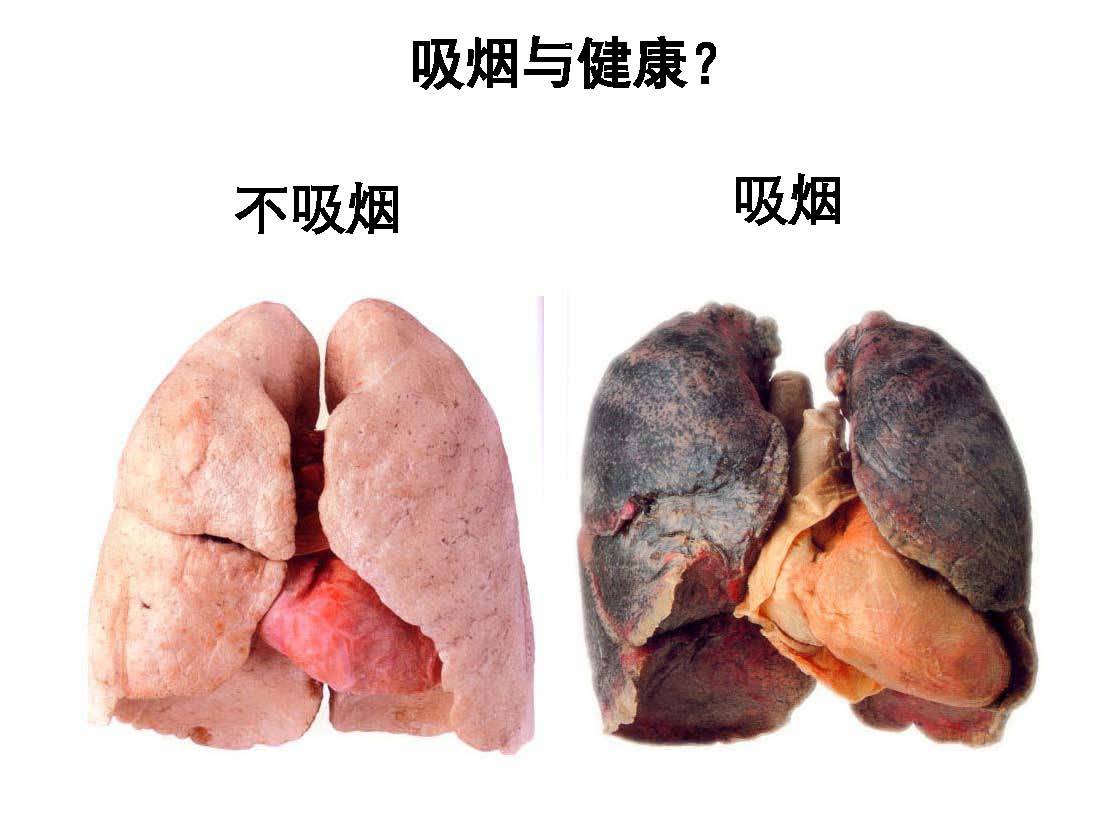
The first slide on smoking showed a healthy lung next to a smoker’s lung

And then she started the discussion on smoking. First a show of hands demonstrated that just about everyone in the room smoked and that it was a substantial portion of their daily budget. No one knew the healthcare costs associated with smoking-related health issues. Some had family arguments because of persistent smoking. And no one knew the hazards of second hand smoking.

The last slide was on nutrition and health. Given that all the migrant workers have their meals covered by their construction companies, my wife feared that they would be eating meals that is not nutritionally balanced. Especially in this last year with severe inflation, she thought that the workers meals would be low in protein and so she suggested that they cook eggs for themselves, drink yogurt, boil peanuts, fry soybeans, buy some prepared foods with meat (but avoid the vacuum-sealed ones) and drink soymilk. (In fact, the last few months, according to the workers, their lunchboxes were basically rice and Chinese cabbage. Not even tofu…)

After the last slide, my wife led the room in a lively discussion. She made special note of one of the workers (a certain Mr. Wu, see photo below) who already knew most of the health information she tried to convey. She told everyone that they should consult Mr. Wu if they had questions. She also tried to answer the questions as best as she could and made notes of those she couldn’t, promising to answer these questions on a return trip.

 Mr. Wu is the one on the right.

At around 7:30, the laptop was swapped for a DVD player. The Zigen workers had been showing the TV serial “Battle for Peking” 战北平 on Saturday nights. On this Christmas Night, the migrant workers started to watch episode 22. A couple of them were impatiently waiting for my wife’s presentation to be over and voiced their opinion loudly when the DVD player was taken out. But these few were immediately hushed by the others. My wife was very touched by the support, as we left and found our way back to ShiGe Zhuang bus stop to wait for one of the buses that would take us back into Beijing city.

Miscellany and Afterthoughts: During my wife’s presentation, I noticed that some of the migrant workers got up and left the room. But they came back in too quickly for a trip to the communal restroom (more than 3 minutes away). So they step outside for a quick smoke. In this regard, these migrant workers respected the “No Smoking” sign more than some of my wife colleagues at the CAS or even some of my colleagues at PKU. When asked, some noted the sign and told us that they did not think it was appropriate for them to smoke inside where there were Zigen workers who were running these community events.

Only one couple came. They sat next to the furnace and next to me. (See photo to the left.) The rest of the migrant workers came up to Beijing without their wife or family.

Most of these migrant workers were from the province of Henan, which was where one of the Zigen workers was from. Henan, 河南, means south of the river; whereas Beijing is in the middle of Hebei, 河北, i.e., north of the river. The river is Yellow River.

It turned out that just about all the migrant workers were owed their paychecks for the last 1-3 months. The construction companies were only covering their meals during this period. Some of the workers tried to get the Changping county government to intervene to no avail. Now they are just hoping to get paid in time for Chinese New Year.

The antibiotics commonly in use are amoxicillin, erythromycin, and tetracycline.

Erguotou (er guo tou) 二锅头 is a typical Beijing spirit, made from a mixture of grains (wheat, corn, sorghum, …), so-called because it is the “head” (头) of the “second pot / distillation” (二锅).

My wife and I are not in any way affiliated with Red Star (红星) which makes the Erguotou in the image above or with Shijiazhuang Pharmaceuticals. It was my wife’s intention to list items that were cheap, safe and easily accessible to the migrant workers.

And finally, a Happy New Year to Everyone!

Written by a newyorkerinbeijing AT gmail dot com on New Year’s Eve 2011.


Friday, December 24, 2010

Friday Night is Movie Night at the CAS


Over the last few weeks, my wife has managed to reserve the large seminar room on the first floor of her building on Friday evenings at 7 PM to show Mao Era Chinese movies. It has been a hit amongst not only her students but students from other labs. Even a couple of the doormen started to show up regularly.


The first two movies in this series were 我们村里的年轻人 (“Village Youngsters”), and 冰山上的来客 (Visitors on Icy Mountain”).


I finally made it to the fourth movie, “Youth in Battle” 战火中的青春


Made in 1959 by Changchun Movie Studios for the 10th anniversary of the founding of the People’s Republic, the main female character Gao Shan was hailed as the contemporary Mulan.

In the opening battle sequence, her father was fell by the Nationalist. Gao Shan managed to escape and showed up at another platoon dressed as a male soldier and was introduced as the newly commissioned deputy platoon leader. No one knew she was a 17 year old girl.

For a while, the soldiers made fun of her height and even the platoon leader told her that he thought that Gao Shan would be better suited as a 文艺兵 (soldier whose main purpose was to entertain the actual combat soldiers). It was only through a few trials and tribulations that Gao Shan finally gained the platoon's respect and trust.

In the main battle, the platoon leader disregarded Gao's advice, took a unnecessary risk and was surrounded by Nationalists. He managed to stay alive until Gao with the rest of the platoon came back for him. But Gao was hurt in this battle and eventually had to go to the hospital where the doctor found out that she was a 17 year old girl.  The platoon leader came to visit and was greeted with this news. He wouldn't believe her until she showed a picture of herself with her deceased father (see picture to the left).

The most famous scene is the closing one, when the entire platoon came through the village where Gao Shan was now stationed. The platoon was on the way to another battle front. The various soldiers marched through trailed only by the platoon leader. Before the platoon leader left, he gave Gao a sword for her to remember their time together in the platoon. Then he ran off. Given that this was filmed in 1959, there was as much love in this exchange as it was allowed by the CCP at that time.

Here’s a link to the closing sequence of “Youth in Battle” (the actual sequence starts at 1:29 in the clip, after the opening credits of the movie)

http://v.youku.com/v_show/id_XMTQ2NjU5MzY0.html

After the movie, as I walked back upstairs, I was affectionately taunted by my wife and her students with the main movie theme which was this song sang at the camp fire scene in the following clip:

http://v.youku.com/v_show/id_XMTUyODE4MDI4.html

The song had its origins in the War Against Japan. But in the movie, set in 1947, instead of the Japanese, the main enemies were the Nationalist and the Americans.

My wife quietly asked me if I was offended. I laughed and said “No!”

Miscellany and Afterthoughts: In 2004, a tribute to Chinese movies produced by Cui YongYuan,  “The Story of Movie” 电影传奇 started its 5 year run on CCTV (2005 being the nominal centennial of Chinese movie industry). Cui, whose love for motion pictures came through in each episode, guided the audience through over 100 classic Chinese movies. In each episode, there were interviews and reminiscences of the director, actors and various others related to the headlined movie, interspersed with actual clip and new re-enactments of major scenes (acted out by Cui himself and various others).

My wife showed the corresponding episode of “The Story of Movie” after each screening to give the students some context.

A couple of weeks ago, there’s a rumor that a new “Story of Movie” produced by Cui is now in the planning stages.

In any case, the next movie on Movie Night will be “Five Golden Flowers” 五朵金花 and if you cannot make it to CAS on Friday night, here’s the youku link to the movie.


And, finally, a Happy Holidays to Everyone!

Corrigendum (12/26/10). In the Dec. 24th posting, I incorrectly wrote squad when I should have written platoon. Thanks to JM for the correction.